
5 Best Mycorrhizal Inoculants That Boost Plant Roots
You’ll compare the top five mycorrhizal inoculants by what they deliver and how to use them. Start with DYNOMYCO’s 100 g for quick root colonization, then evaluate Myco Bliss Powder’s 5-strain mix at 1,000 propagules per gram for broad support. Consider MycoLife 5x for precise counts, Big Foot’s direct-root method, and Organic Root Stimulator & Soil Activator for nutrient uptake. After listing steps and options, decide which fits your plants and setup, then move to implementation.
| DYNOMYCO Mycorrhizal Fungi Inoculant (100g) |

| Best Overall | Active Content Type: Granular mycorrhizal inoculant | Target Benefit (Root growth emphasis): Explosive root growth | Application Versatility (use in multiple settings): Indoor-to-outdoor versatility | VIEW LATEST PRICE | Read Our Analysis |
| Myco Bliss Powder: 5-Strain Mycorrhizal Inoculant |

| Budget-Friendly Pick | Active Content Type: Powder inoculant | Target Benefit (Root growth emphasis): Enhances nutrient uptake/root growth | Application Versatility (use in multiple settings): Indoor/outdoor; seeds, soil, roots | VIEW LATEST PRICE | Read Our Analysis |
| MycoLife 5x Mycorrhizal Inoculant for Plants |

| Professional Strength | Active Content Type: Powder inoculant | Target Benefit (Root growth emphasis): Better root development | Application Versatility (use in multiple settings): Indoor & outdoor; soil, containers | VIEW LATEST PRICE | Read Our Analysis |
| Big Foot Mycorrhizae: 7,500 Spores 4 oz Package |

| Easy-Application Champion | Active Content Type: Granules | Target Benefit (Root growth emphasis): Boost growth and root development | Application Versatility (use in multiple settings): Lawns, gardens, potted plants | VIEW LATEST PRICE | Read Our Analysis |
| Mycorrhizal Fungi: Organic Root Stimulator & Soil Activator |

| Organic/All-Nureal Bio-Formulation | Active Content Type: Soluble granular | Target Benefit (Root growth emphasis): Expands root absorption area | Application Versatility (use in multiple settings): Vegetables, fruits, flowers, containers, raised beds, hydroponics | VIEW LATEST PRICE | Read Our Analysis |
More Details on Our Top Picks
DYNOMYCO Mycorrhizal Fungi Inoculant (100g)
DYNOMYCO Mycorrhizal Fungi Inoculant (100g) is a strong pick for beginners and seasoned growers seeking rapid root colonization. You apply the granular formula directly to transplant holes or seed-starting media. Measure: use the pouch’s guidance, up to 20 plants per 100 g. Place inoculant in the root zone during transplant or mix into potting holes, then cover with soil. Expect 900 propagules per gram to initiate quick colonization, improving nutrient uptake and root thickness. It’s versatile for indoor or outdoor use and compatible with coco, raised beds, and seedlings, with minimal dust and no slurry. Verify safety and OMRI/ECOcert status.
- Active Content Type:Granular mycorrhizal inoculant
- Target Benefit (Root growth emphasis):Explosive root growth
- Application Versatility (use in multiple settings):Indoor-to-outdoor versatility
- Plant Coverage (treats per package):Treats up to 20 plants per 100 g
- Safety/Organic/Non-synthetic:OMRI Listed; safe for kids/pets/pollinators
- Strain/Species Detail Clarity:Desert-adapted strains (specifics not labeled)
- Additional Feature:Granular, low-dust formula
- Additional Feature:Treats up to 20 plants
- Additional Feature:OMRI Listed; ECOcert approved
Myco Bliss Powder: 5-Strain Mycorrhizal Inoculant
Myco Bliss Powder stands out for its 5-strain formulation, designed to boost nutrient uptake and root development. You use this powder inoculant to treat soils, seeds, or developing roots. For indoor and outdoor plants, mix 1–2 tbsp per gallon of potting soil. Apply directly to seeds or roots before planting, then water normally. The product provides 1,000 propagules per gram and treats up to 100 plants per pound, supporting beans, peas, lawns, flower beds, containers, and beds. It’s a highly concentrated, sustainable option with no synthetic ingredients, reducing fertilizer needs while improving moisture storage and stress tolerance. Packaging: Plantonix, 1 lb.
- Active Content Type:Powder inoculant
- Target Benefit (Root growth emphasis):Enhances nutrient uptake/root growth
- Application Versatility (use in multiple settings):Indoor/outdoor; seeds, soil, roots
- Plant Coverage (treats per package):Treats up to 100 plants per pound
- Safety/Organic/Non-synthetic:Sustainable; no synthetic ingredients
- Strain/Species Detail Clarity:5 high-performing strains; 1,000 propagules/g
- Additional Feature:Powder inoculant format
- Additional Feature:1,000 propagules/gram concentration
- Additional Feature:Treats up to 100 plants per pound
MycoLife 5x Mycorrhizal Inoculant for Plants
This product offers professional-strength mycorrhizal support for both home gardens and containers. You mix MycoLife 5x with water, then apply to soil, containers, or raised beds. For best results, use 1/2 teaspoon per 1-gallon plant container and water promptly. It contains 245 active spores per gram, with precise spore counts labeled, ensuring reliability. Treat 20 one-gallon containers or up to 860 square feet. It improves nutrient uptake, drought resistance, and disease resistance, promoting root development and uniform canopy growth. Follow directions for soil or container use, and monitor plant response, adjusting watering and feeding as needed.
- Active Content Type:Powder inoculant
- Target Benefit (Root growth emphasis):Better root development
- Application Versatility (use in multiple settings):Indoor & outdoor; soil, containers
- Plant Coverage (treats per package):Treats 20 one-gallon containers or equivalent
- Safety/Organic/Non-synthetic:Natural/safe AMF-based
- Strain/Species Detail Clarity:245 active spores per gram; notes on viability
- Additional Feature:245 active spores/gram
- Additional Feature:Ground root/hyphae fragments noted
- Additional Feature:Treats 20 one-gallon containers
Big Foot Mycorrhizae: 7,500 Spores 4 oz Package
Big Foot Mycorrhizae, with 7,500 spores in a 4 oz package, is an easy-application champion for gardeners seeking robust root growth. You apply it directly to roots or mix with soil. The granules cover 5 tbsp per cubic foot of soil, or 3 lbs per yard, and treat up to 30 plants. Made in Grants Pass, Oregon, USA, it’s safe for pets and kids and long-lasting for the plant’s life. Use the 4 oz package to fertilize lawns, gardens, and potted plants. Follow the directions for larger plants and adjust granule amounts accordingly.
- Active Content Type:Granules
- Target Benefit (Root growth emphasis):Boost growth and root development
- Application Versatility (use in multiple settings):Lawns, gardens, potted plants
- Plant Coverage (treats per package):Treats 30 plants
- Safety/Organic/Non-synthetic:Safe for pets/kids; USA-made
- Strain/Species Detail Clarity:High spore count (7,500 spores/package)
- Additional Feature:7,500 spores per package
- Additional Feature:4 oz package with 4 liters liquid coverage
- Additional Feature:USA-made; 2-year warranty
Mycorrhizal Fungi: Organic Root Stimulator & Soil Activator
Looking for a reliable root boost? Use Mycorrhizal Fungi: Organic Root Stimulator & Soil Activator. This product contains a laboratory-grade Rhizophagus irregularis strain, 500-million-year symbiosis, and 4.23 oz of soluble granules. It expands root absorption via a vast fungal network, improving nutrient uptake, root development, drought tolerance, and stress resilience. It reduces transplant shock and supports lush foliage, sweeter fruit, and heavier buds. Follow steps: mix a small amount per planting or seed starting, water in, and apply during containers or in-ground gardening. Suitable for vegetables, fruits, flowers, and potted plants; not ideal for brassicas or most trees.
- Active Content Type:Soluble granular
- Target Benefit (Root growth emphasis):Expands root absorption area
- Application Versatility (use in multiple settings):Vegetables, fruits, flowers, containers, raised beds, hydroponics
- Plant Coverage (treats per package):Treats up to 50 plants
- Safety/Organic/Non-synthetic:Organic and natural; AMF-based
- Strain/Species Detail Clarity:Rhizophagus irregularis single strain; lab-grade
- Additional Feature:Humic acid + sugars boost
- Additional Feature:120 g treats up to 50 plants
- Additional Feature:Rhizophagus irregularis single strain
Factors to Consider When Choosing Mycorrhizal Inoculants
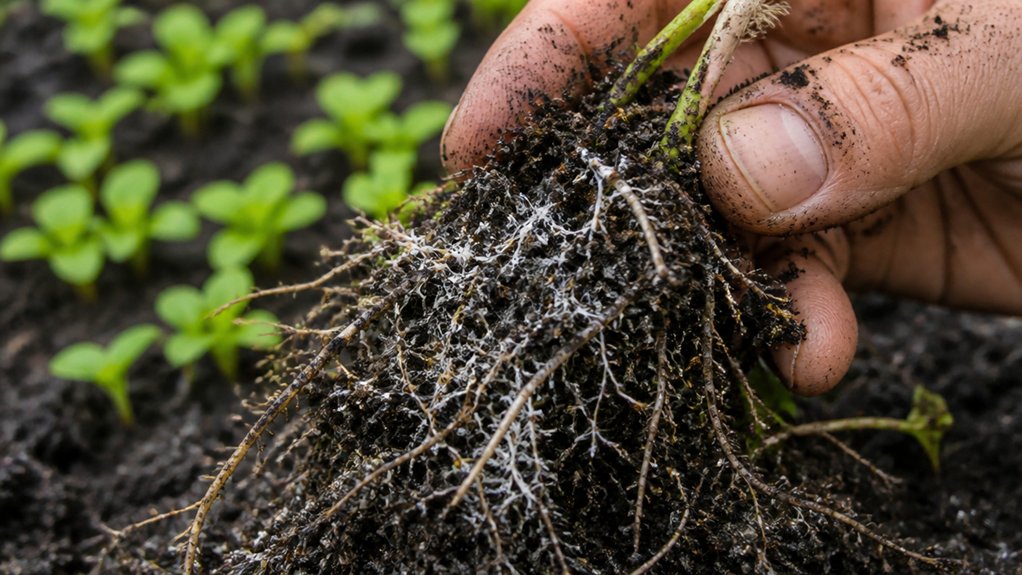
Start by evaluating inoculant strain selection, noting which strains target your plant type and local conditions, and then check each option for documented compatibility with your crops. Next, assess propagule count and formulation, comparing active units per gram or per package and choosing one that ensures a reliable should-be-establishment dose for your setup, whether pots, beds, or turf. Finally, review application method ease, soil type suitability, and the practical steps needed for labelling, storage, and timing, selecting products that come with clear instructions and proven performance in your environment.
Inoculant Strain Selection
Choosing the right inoculant strain starts with understanding how different species perform in your setup. First, identify strains with proven root colonization rates and distinct nutrient uptake benefits for your crop type. Compare propagule count per gram (e.g., 500–900 propagules/g) and total viable spores, since this affects how quickly roots are inoculated and how thoroughly colonization occurs. Check if the product discloses exact active spore counts per gram, not just non-viable material, for realistic expectations. Next, assess compatibility with your growth medium and application method—soil, seed coatings, or hydroponics—and note which strains perform best in each scenario. Finally, consider longevity and stress tolerance to preserve benefits through transplant shocks or drought, ensuring strain persistence fits your environment.
Propagule Count Relevance
Propagule count matters because it directly affects how quickly and how thoroughly mycorrhizal networks establish. You measure propagules per gram, per package, or per application, and compare totals to your project size. Higher density, like 900 propagules/g, often yields faster root colonization and larger networks, but not guaranteed if viability or compatibility are poor. Check viability notes on the label and verify whether non-viable components are included, then adjust counts accordingly. Consider total treatment capacity and how many plants you plan to inoculate; ensure the product matches your field or pot setup. Assess application method—seed coating, root dipping, or soil placement—and align with plant species and soil conditions for best results. Balance cost, practicality, and expected performance to choose the right propagule count.
Plant Compatibility Range
Selecting the right mycorrhizal inoculant starts with knowing which plants you’ll grow and where they’ll be placed. Start by checking plant compatibility on the label, noting whether the product covers vegetables, ornamentals, fruiting crops, or excludes brassicas or certain trees. Next, consider spore or propagule counts per gram, since higher counts often improve host range and colonization speed across species. Decide if you need a universal indoor/outdoor product or one tailored to containers, raised beds, or seed starting mixes. Identify whether the inoculant targets seed starting, cuttings, or mature plantings, and align with your production stage. Finally, review if multiple strains are included, which can broaden host range but may carry species-specific guidelines.
Application Method Ease
When evaluating application method ease, start by noting how the product is delivered. Granular formulations reduce dust and mess, making around-transplant or in-potting use easier than powders or slurries. Some products specify exact placement, such as in transplant holes or root zones, to optimize colonization at observe root tips. Application guidance often includes per-plant or per-volume rates, for example 1/2 teaspoon per plant or 5 tablespoons per cubic foot, ensuring consistent dosing. Powder formats require mixing with soil or water before use, adding a preparation step compared to ready-to-use granules. Instructions may state target uses like seedlings, containers, or beds to align inoculant type with method and minimize handling issues. Follow the included steps exactly for reliable results.
Soil Type Suitability
Soil type matters when choosing mycorrhizal inoculants, because different textures and conditions affect how well the fungi colonize roots. First, note texture compatibility: some products perform best in sandy soils, others in loamy or clay soils, depending on moisture retention and drainage. Next, assess soil amendments: humic acids and added organic matter can improve colonization in nutrient-poor soils by boosting microbial activity. Then, match pH: select inoculants that tolerate your soil’s pH to maximize root association. Consider formulation: granular products reduce dust and suit raised beds or ground soil, while powders require careful mixing for even distribution. Finally, evaluate stress tolerance: soils with high salinity or drought may need inoculants labeled for abiotic stress tolerance to maintain efficacy.
Longevity Of Benefits
Longevity of benefits hinges on how long AMF colonization lasts and how durable the hyphal networks are in your soil. You assess persistence by soil health, moisture, pH swings, and crop type. Expect some products to promise life-of-plant effects, but verify duration with field notes and label data. Choose granular formulations when you want slower, sustained soil colonization and longer-term activity, compared to liquid or slurry formats. Favor systems with reduced disturbance and continuous organic matter input, as these support lasting fungal networks. Consider products with multiple strains or humic substances, which can influence persistence and the need for reinoculation. Plan a maintenance schedule based on test results, reseeding plans, and cropping cycles to sustain benefits across seasons.
Safety And Organic_OK
Organic_OK safety matters when selecting mycorrhizal inoculants. You verify organic compliance by checking certifications like OMRI or ECOCert and noting any organic standards claims. You assess labeling for spore and propagule counts to judge safe, controlled colonization without harming people, pets, or pollinators. You prefer granular or powder formulations with minimal dust to reduce respiratory exposure and handling risk. You verify the product’s composition to ensure absence of heavy metals and synthetic chemicals, aligning with organic soil ecosystems. You compare options by confirming compatibility with your growing system, then follow application directions exactly to avoid overuse. You document certifications, batch numbers, and disposal methods. You choose products that provide clear safety data sheets and contact manufacturer support for any ambiguities.
Packaging And Storage
Packaging and storage choices affect how well your mycorrhizal inoculants perform. You decide on a format that fits your project: granular, powder, or soluble granules. Each format changes handling, dust exposure, and how easily you mix with soil or water. Check propagule density, which ranges roughly from 245 to 900 propagules per gram, to estimate inoculation efficiency per weight. Use the product’s coverage guidance to determine how much to apply per plant or per volume of soil. Look for desiccants or protective packaging that extend shelf life and keep viability, or choose standard bags or pouches if that’s listed. Store in a dry, cool spot to preserve spores until you’re ready to use them.
Final Thoughts
To choose, compare spore counts, formulation, and application. If you want quick root colonization, pick DYNOMYCO’s granular 100 g or Big Foot’s easy direct-root package. For multi-strain balance, use Myco Bliss Powder or MycoLife 5x with precise counts. If you seek soil activation alongside nutrients, choose Organic Root Stimulator & Soil Activator. Follow label directions, match your plant type, and apply at planting or transplanting. Track results, adjust dosage, and reapply as needed.
Related Posts


About The Author

LED Guru
An experienced veteran when it comes to growing indoors, hydroponics, and organics. LED Guru shares a massive amount of knowledge about LED growing and how to do it best.